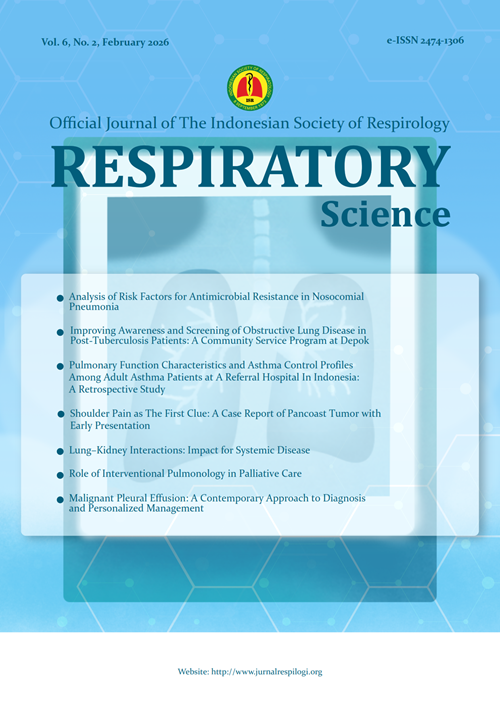
Role of Interventional Pulmonology in Palliative Care
DOI:
https://doi.org/10.36497/respirsci.v6i2.200Keywords:
airway obstruction, bronchoscopic intervention, interventional pulmonology, lung volume reduction, malignant pleural effusion, palliative careAbstract
Interventional pulmonology (IP) is a minimally invasive approach that plays a pivotal role in the evaluation and management of advanced thoracic diseases within palliative care. By integrating bronchoscopic and pleural techniques, IP provides effective symptom relief without the need for extensive surgical procedures or prolonged hospitalization. In malignant central airway obstruction, stenting, cryotherapy, and laser debulking offer rapid improvement in airflow and quality of life. For malignant pleural effusion, thoracentesis, pleurodesis, indwelling pleural catheters, and intrapleural fibrinolytic therapy for septated effusions provide safe and cost-effective strategies for symptom control. In selected cases of severe emphysema, bronchoscopic lung volume reduction using endobronchial valves improves lung mechanics and exercise capacity. In contrast, one-way endobronchial valves and spigots are valuable in managing persistent air leaks. With high procedural success rates and favorable safety profiles, IP is broadly applicable across diverse palliative respiratory conditions. Overall, IP provides a safe, effective, and patient-centered solution that complements standard palliative care, ensuring optimal quality of life while minimizing invasive burden.
Downloads
Published
How to Cite
Issue
Section
License
Copyright (c) 2026 Respiratory Science

This work is licensed under a Creative Commons Attribution-NonCommercial 4.0 International License.